




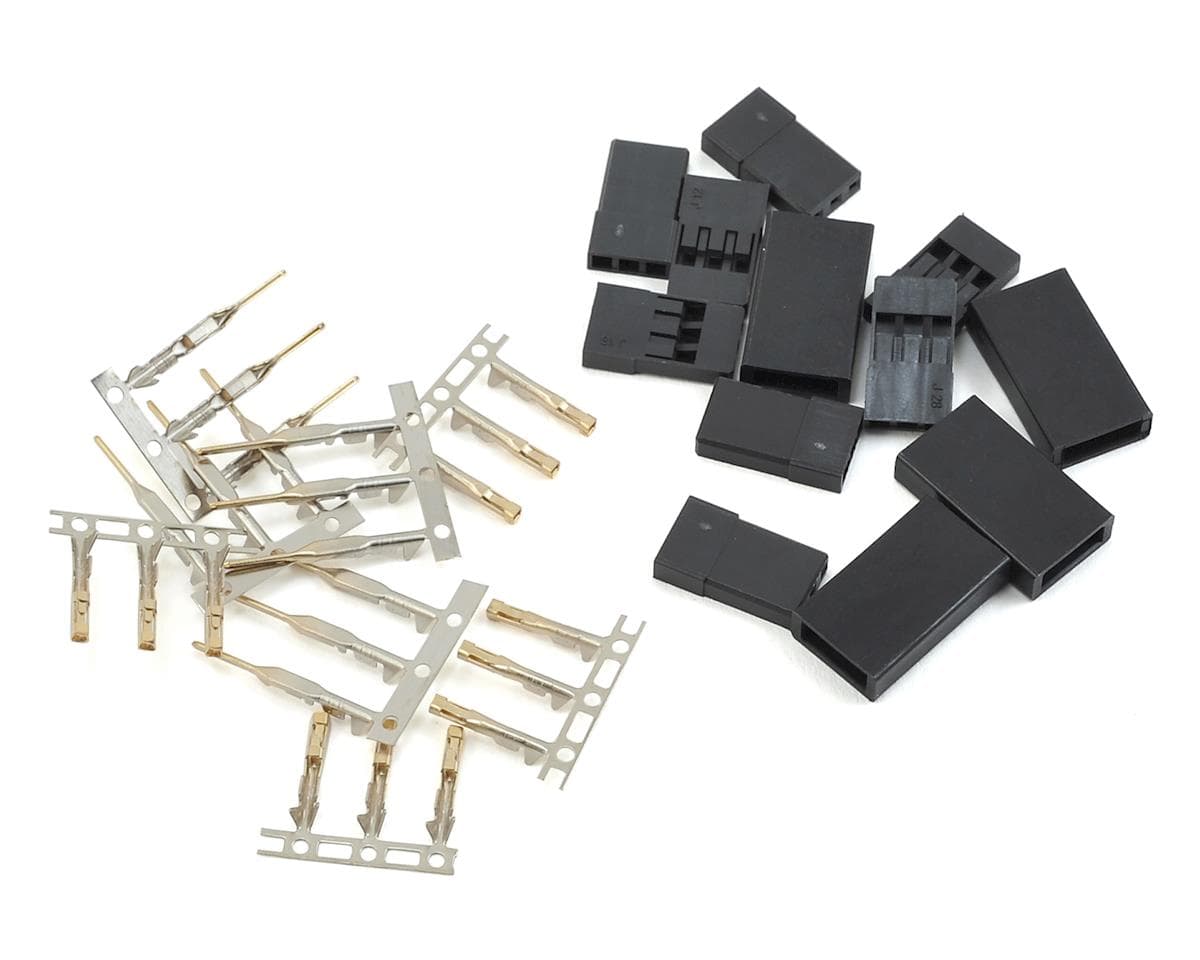
ProTek RC JR Style Servo Connectors (4 Pair)
About this part
This is a pack of four pairs of JR style servo connectors. Included are four female and eight male connector housings and eight sets of connector pins. These are unassembled, and can be used to repair a bad servo lead, or to construct your own servo or battery connectors.
CA Residents Prop 65 Warning
WARNING: This product can expose you to chemicals including Di(2-ethylhexyl)phthalate (DEHP), which is known to the State of California to cause cancer and birth defects or other reproductive harm. For more information go to www.P65Warnings.ca.gov Details...Reviews3.3 · 4 reviews
GREAT parts. I was in a bind installing a part that did not come completely assembled. this kit saved me.
These do not work in Sanwa Brand Receivers. So hard to find headers that work in sanwa
Oh. I don't like these one bit. I'm using proteks crimp tool and it looks like I'm using it correctly, but these pins keep popping out of their housing. It will get the job done but it's very easy to yank these out of the housing when trying to disconnect from the reciever.
Great parts for doing some wire management. Takes a few to figure it out, but once you know what to do its a piece of cake. I always keep these in my spares box
Four verified-owner reviews with mixed ratings averaging about 3.25 out of 5. Two reviewers rate the connectors highly, praising their usefulness for wire management and as a quick repair kit, though one notes a learning curve before they are easy to use. The two lower ratings report problems: one says the connectors do not fit Sanwa brand receivers, and another says the pins pop out of the housing during crimping and are easily pulled out when disconnecting from the receiver. Reviewers do not agree on overall quality, and the sample is small.
- + Useful for wire management
- + Handy as a spare or repair kit
- + Easy to use once learned
- − Does not fit Sanwa receivers
- − Pins pop out of housing
- − Pins easily pulled out when disconnecting
- − Learning curve for first use